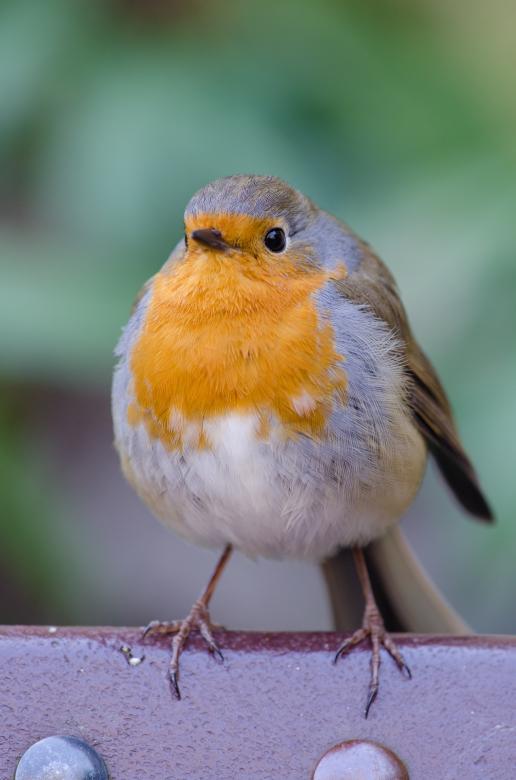
Reference photo: "Cute Robin" by Pixabay on
Stockvault.net
(Free Stock Photo)
An experiment in AI-generated SVG art
Redraw: front-facing robin with bokeh background, orange breast, feather texture — testing improved model capabilities.
Redraw: side-profile blue jay with crest, black necklace, wing bars, layered tail feathers on a branch.
Redraw: perched hummingbird with hand-placed iridescent teal spots, long beak, dark tropical background.
Redraw: flat geometric robin illustration — same reference, testing whether model improvements yield closer match.
Tenth attempt: same reference, SVG coordinates generated automatically by pixel boundary scanner + RDP simplification — no manual coordinate entry.
Ninth attempt: same reference, drawn as coloured bezier stroke outlines only — no fills, pure line art.
Eighth attempt: same reference, every shape built from <polygon> triangles only — pixel-scanned coordinates, fan tessellation, and strip tessellation.
Seventh attempt: same reference, but every shape drawn with cubic bezier <path> only — no <ellipse>, <circle>, or <rect> primitives.
Sixth attempt: reproducing a flat geometric illustration from baseline.jpg — different challenge from photorealistic work.
Fifth attempt: a golden Thai omelette with spring onions and garnishes — first non-bird subject, 5 render-feedback iterations.
Fourth attempt: an emerald-speckled hummingbird with iridescent plumage using feTurbulence for organic spots.
Third attempt: drawing a Blue Jay with distinctive crest, blue plumage, and white markings.
Second attempt: tracing over the reference photo using matched pixel coordinates. Includes overlay toggle.
First attempt: drawing a European Robin from scratch using SVG paths, gradients, and filters.
What worked, what didn't, and what an AI learns about drawing birds in SVG.